

Trans people are more likely to get Long COVID.
Research, resources, and how to keep each other safe.
Trans people are more likely than cis people to get Long COVID. You can find more information about this correlation at Long COVID Justice and from Trans Health Research.
We’re inspired by trans and queer people who are taking steps to protect themselves and others from this and other disabling illnesses.
You can check out some of their masked costumes on Instagram, like this vampire outfit for a Halloween dance party, these Halloween costumes, these outfits from Comic Con, this headgear, and creative ideas from this nonbinary cosplayer.
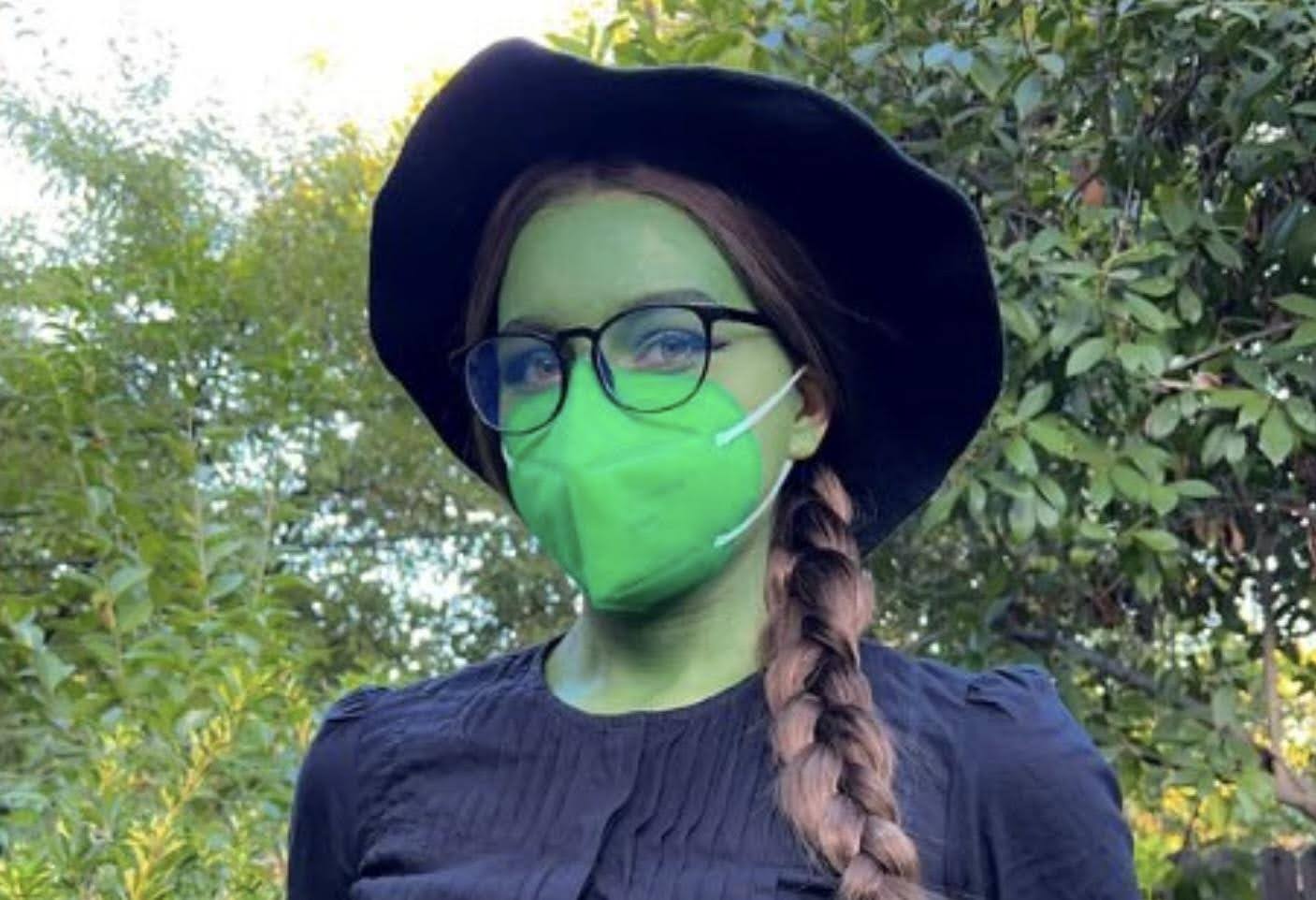
This is an image of @the3mmadil3mma dressed as Elphaba from Wicked with green face paint and a green mask, as posted by @maskcurious in the second link above.
At Trans Lifeline, we know that trans liberation and disability justice are deeply connected. Trans and disabled people live in a world that’s often hostile to us, and we fight for our dignity and self-determination.
Trans Lifeline pushes back against stigma, bigotry, and oppression – while prioritizing autonomy, informed consent, and equity for trans people and other marginalized communities.
The people who call our hotline frequently ask for support with navigating Long COVID.
So we compiled information and resources to share with you and your community.
(Note: There’s a lot of information here, so feel free to bookmark this page to come back to. There are plenty of links to useful resources throughout, and the last few paragraphs include key resource pages and guides about Long COVID.)
You may feel fear, sadness, or alienation if you’ve already been impacted by COVID infections, or you may have anxiety about what could happen to you. And you might be dealing with so much already that it’s hard to even think about COVID. That makes total sense.
COVID is still here, and anyone can develop long-term problems from their next infection. Dr. Ziyad Al-Aly explains that Long COVID is “a complex, multisystem disorder that can affect nearly every organ system and can be severely disabling.”
But as trans people, we have experience with keeping each other safe and taking care of each other. And there is empowering information about steps we can take to do so.
We can integrate information about Long COVID into our lives and find joy, connection, meaning, and love. As this artist explains in a series of Instagram slides, people who take precautions to avoid COVID infections are living in love, not fear.

Graphic from @radicalbirding on Instagram, which features two masked people on a bike. It says “Protecting yourself from COVID and living life with joy are not mutually exclusive. We can have both.”
COVID never went away.
You can find information and links below about options for how we can protect ourselves and our communities, such as wearing masks regularly, getting or making an air purifier, getting a COVID vaccine at least once a year, testing if you have symptoms or had a known exposure, and/or aiming for more outdoor gatherings. We also included links to programs and organizations that help people access these tools.
Taking steps to protect people from COVID doesn’t have to interfere much with our lives.
Meanwhile, becoming disabled or more disabled because of repeated COVID infections will absolutely make our lives harder – and sometimes more isolating.
Protecting ourselves and others is life-affirming, as this trans person explains. It’s a way of asserting that we matter. Lots of people are already doing it, which you can see in Instagram posts from this nonbinary person, these nonbinary people, and this nonbinary person.
If you have disabilities or conditions like Long COVID, you are not alone. Millions of people in the U.S. and Canada have become disabled from COVID infections, as Michael Hoerger from the Pandemic Mitigation Collaborative shows in this post about the fall 2026 surge.
At least 17 million U.S. adults have Long COVID, which is a collection of wide-ranging symptoms that vary per person. COVID can activate or worsen many specific and diagnosable issues, such as diabetes, blood clots, and ME / Chronic Fatigue Syndrome. Many people consider these to be part of Long COVID, as well as their own distinguishable conditions.
People with disabilities and chronic illnesses, such as Long COVID, have set up many spaces to connect with each other, support each other, and share their expertise about what they’ve tried that worked for them. This includes online forums such as Facebook groups.
This way of learning information can be much more helpful than what people hear from their healthcare providers. For example, many doctors don’t wear masks and don’t understand Long COVID. As many trans people know, the medical field can take decades to catch up to scientific reality.
There are also COVID-aware organizations all around North America and the world.
These include mask blocs (which distribute masks for free, and often other supplies like COVID tests or air purifiers), clean air organizations that provide air purifiers and other safety supplies, other COVID-conscious mutual aid groups (such as this one in Richmond, VA), and groups hosting COVID-safer events (like Positive Deviance in NYC and Maskquerade in Vancouver).
To find people near you who care about this, check out this COVID Action Map, which features advocacy groups, clean air organizations, virtual networks, community groups throwing events, and COVID-safer community spaces.
Taking precautions to minimize the risk of getting COVID is community care, and it can be rooted in abolitionist values. It’s a way to live out the understanding that no one is disposable.

Photo from @positivedeviancenyc and @leslieroth on Instagram, showing a crowd of people with various racial backgrounds and styles wearing N95 masks at a mask-required dance party.
COVID is an airborne virus that’s still spreading, and there’s a surge right now (in late 2026).
Infectious people breathe out tiny particles that can travel far and linger in the air for hours, especially in places without much air flow or ventilation. N95 masks (that fit well) block those particles from going in or out, which is why some people wear them to protect themselves and others.
Anyone can get Long COVID, even if they have “mild” initial symptoms while contagious (during the first week or two, or sometimes more).
But people’s experiences with Long COVID differ based on their positions in our oppressive system.
For example, Black, Latiné, and Indigenous people are more likely to be impacted by Long COVID. Despite that, Black patients are less likely to be diagnosed for Long COVID. People who already have underlying conditions are particularly susceptible. And trans people are four times more likely to develop severe Long COVID symptoms than cis people.
Relatedly, people who don’t have access to health insurance or sick days will be more affected than people who have more privilege and security. This is true during the first week of a COVID infection and beyond. Low-wealth people will struggle more than wealthy people if they develop disabilities that leave them unable to work and unable to afford care.
Taking steps to avoid getting and spreading COVID is about class justice, racial justice, trans justice, disability justice, and more.
Most people living in North America have had COVID multiple times. Millions of people are still getting COVID every week in the United States. (Scroll down on this page to see some estimates, such as daily and weekly infections.)
With each new infection, the risk of getting Long COVID goes up (including the risk of damage to our immune systems, organs, and blood and cells). COVID tends to persist in the body long after you may experience your initial symptoms, and studies are showing that COVID’s impacts on the immune system share some similarities with some of HIV’s impacts.
There are several prescription medications that help with lowering the odds of getting Long COVID:
- Xocova just got approved for use within 72 hours after exposure, to hopefully prevent infection. Some health insurers cover the high cost (scroll down on this page to see more about that), and some low-cost clinics may offer it.
- If you’re already testing positive for COVID, your best bet is trying to get on Paxlovid or Metformin temporarily (or both!). Check to make sure they don’t have negative interactions with medications you’re currently taking. Paxlovid’s cost should be covered by Medicaid, or you may be able to use PAXCESS.
Check out guides for what to do if you get COVID from Rthm and Clean Air Club, including recommended supplements and over-the-counter medications to take during the acute period of infection – the first one or two weeks, while actively infectious – to lower your odds of getting Long COVID. Make sure to protect other people during this time as well.
One important thing to do during and after the acute phase of a COVID infection is to rest: rest your body and your mind as much as possible for as long as possible. This is hard to do under our oppressive system, but if you can, it’s good to temporarily cut back on activities, including tasks that require a lot of mental energy, to lessen the chances of long-term or permanent damage.
Rest is also important for people who already have Long COVID. Pushing through fatigue can sometimes make symptoms much worse.
You may not know when you’re sick, or if people around you are sick. About 40-50% of COVID cases are asymptomatic, meaning they don’t involve symptoms – but even without symptoms, people who have COVID can spread it & can later develop Long COVID.
To see if you have COVID, you can try to take a test. Here are some options:
- A mask bloc near you may be able to send you “rapid tests,” or antigen tests, which are usually the most affordable and accessible COVID tests. They’re sometimes covered by insurance. To increase rapid tests’ accuracy, it’s best to test multiple times over the course of a few days.
- If you have health insurance, it may cover a more accurate PCR test, which is a type of molecular test that some urgent care centers, pharmacies, and healthcare facilities provide.
- For those in the U.S. who can afford it, Aptitude Medical sells at-home molecular tests that are much more accurate than rapid tests, along with a reader to run the tests.
- Canadians can order Pluslife tests and docks/readers from Altruan to get even more accurate at-hone results. Each Pluslife test is a lot more affordable than a test from Aptitude Medical. Altruan also sells extra swabs, so people can “pool” tests and save money by having 2-3 people swab their noses for one test.
The best way to truly prevent Long COVID is not getting COVID-19.
We can limit exposure to COVID-19 to reduce the chances of getting infected. Here are are the top options:
- Wearing well-fitting N95 masks, especially when indoors in public places. As mentioned earlier, COVID-19 is primarily airborne, which means people get it and spread it by breathing in and out tiny virus particles that can stay in the air for a while, like smoke. N95 masks are specifically designed to block particles of this size, protecting the mask wearer and the people around them – when worn regularly and correctly.
- To find free masks, look for a mask bloc near you. They can give you different types of masks that you can try to see which type fits you best and which feel comfortable for you.
- And for those who can afford it, people can order from reputable sites like Project N95, The Face Mask Store, and Industrial Safety Products.
- Well-fitting N95 masks, which are also known as respirators, also help protect wearers from allergens (like pollen and mold) and wildfire smoke. They also protect people from getting and spreading other airborne illnesses like measles, tuberculosis, flu, and pneumonia.
- COVID can spread easily indoors and it can still spread outside, especially in crowds or if you’re staying close to other people.
- If the only kind of masks you can access are surgical masks, there are tools and techniques to make them fit and seal better on your face to improve protection.
- Relatedly, there are ear saver tools that can modify any kind of “ear loop” mask (such as surgical and KN95 masks, which have straps that fit around each ear) to make them more effective – by connecting the loops so they go around the back of your head (like “headstrap” masks).
- Ventilation and air purification are other important ways to lower the risk of getting or spreading COVID; they help COVID particles disappear faster. For example, you can plan to gather outdoors (especially in the breeze), open windows and turn on a fan if spending time inside with others, and turn on air purifiers to clean the indoor air (which you can build yourself or borrow from clean air lending libraries).
- Staying updated on vaccines can help reduce the risk of developing Long COVID, as well as the risk of hospitalization during the acute stage of infection (while contagious, or in the first few weeks). More info:
- COVID vaccines provide real but short-term protection, and the SARS-CoV-2 virus mutates regularly to form new variants, so getting an updated vaccine every 6 or 12 months helps your immune system fight back more effectively if you get infected. (This is especially important because COVID can permanently damage our immune systems, which scientists have said shares some patterns with some of HIV’s impacts.)
- In addition to vaccines like Moderna and Pfizer, every fall the company Novavax releases updated FDA-approved vaccines called “Nuvaxovid,” which tend to have fewer side effects, and are sometimes covered by health insurance. Many pharmacies have these options.
- To access free or low-cost vaccines, find community health centers, public health departments, free clinics, or mobile clinics in your city or region, and check if they provide COVID vaccines for free. Some may also provide free COVID tests. The Mobile Health Map features 392 clinics serving trans and queer people across the US.
While COVID can spread anytime, you can stay informed by checking if there’s a surge happening near you at https://pmc19.com. Many places no longer track this data, but the folks at the Pandemic Mitigation Collaborative are compiling available U.S. wastewater information each week.
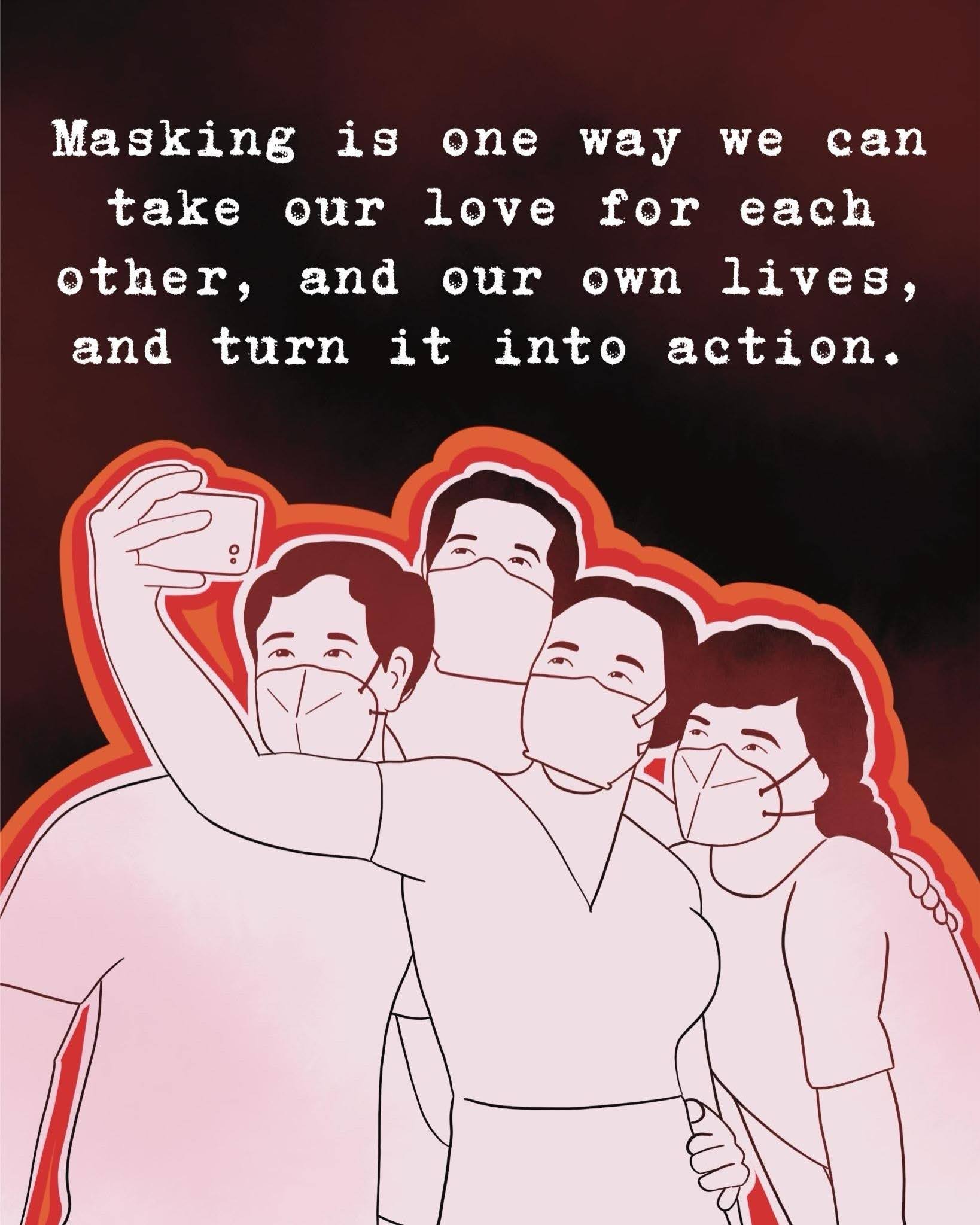
Graphic made by @radicalbirding on Instagram, featuring 4 masked people taking a selfie and the words: “Masking is one way we can take our love for each other, and our own lives, and turn it into action.”
More Long COVID resources:
You can find more information about Long COVID and how to treat it at Long COVID Justice (including resource sheets, a resource hub, support groups, and other places to connect with people) and Rthm, which provides treatment options.
The Patient-Led Research Collaborative and Rthm teamed up to make the Long COVID Treatment Guide (see the page for patients or the similar page for clinicians). This will likely be helpful for you as well as for your healthcare provider(s).
You can also learn more and stay up-to-date by following The Sick Times on Instagram, signing up for their newsletter, or listening to their podcast.
And you can sign up for updates about clinical trials for Long COVID treatments with the Patient-Led Research Collaborative, which also has a 2026 Long COVID fact sheet. The RECOVER initiative is also running clinical trials and studying Long COVID.
We can protect each other and ourselves. We can help keep each other safe.
Recent
- Trans people are more likely to get Long COVID.

- A Sweet Farewell from our Executive Director, Dante Alviar Horton

- Our Impact: Download the Trans Lifeline 2025 Annual Report
- Announcing our Microgrants Program Relaunch!
- We Aren’t Going Anywhere: Our Response to Cuts to 988’s LGBTQ+ Youth Service